Uruguay’s power grid is regularly cited as the reason Google chose Canelones for an USD 850 million data centre, and that project is in turn cited as the start of a new wave of corporate property demand. Both claims contain something true. Both are looser than they appear.
This article follows the chain — energy, infrastructure, real estate — and marks the points where it holds and where it thins out. The short version: the energy advantage is real, the investment is real, and the property consequence is narrower, slower and further along than most coverage suggests.
The grid, counted correctly
In 2025 roughly 98% of Uruguay’s electricity generation came from renewable sources, according to the Ministry of Industry, Energy and Mining (MIEM) preliminary balance. Structurally the figure holds above 90% year after year, varying with the hydrological cycle, and UTE has managed the system without the blackouts or rationing seen in neighbouring economies during severe droughts.
One methodological point matters, because the numbers are routinely mixed. The generation split most often quoted for 2025 — hydro 46%, wind 34%, biomass 14%, solar 4% — is measured on the SIN basis, meaning energy actually delivered to the National Interconnected System, as reported by ADME. MIEM’s national basis counts all generation including self-producers, principally the pulp mills that burn biomass on site without injecting it into the grid, and on that basis biomass weighs roughly twice as much.
Taking the headline percentage from one basis and the breakdown from the other is the most common error in descriptions of the Uruguayan matrix. Either cite 98% on MIEM’s basis without the split, or cite the split as ADME’s.
For an electricity-intensive user, what matters in either case is the combination of stability and clean origin. That is a genuine location factor, not a sustainability footnote.
What Google actually said about why it chose the site
The project sits in the Parque de las Ciencias free zone at Ruta 101, km 23.500, Colonia Nicolich, in Ciudad de la Costa, Canelones. It is Google’s second wholly owned data centre campus in South America, joining a network of 28 centres across 11 countries.
On the reasons for the choice, precision is worth keeping. Eduardo López, president of Google Cloud for Latin America, cited access, connectivity and energy availability, and praised the department’s legal security. Energy availability is not the same claim as energy renewability. It was Industry Minister Elisa Facio — a government official rather than the company — who highlighted the project’s environmental sustainability, and specifically its air cooling.
The renewable matrix plausibly forms part of the picture, particularly for a company with global carbon commitments. But the article-level claim that Google named it as a central factor overstates what is on the record.
The project, at its actual scale
Two facts about the Canelones data centre are usually omitted, and both bear directly on any property thesis built around it.
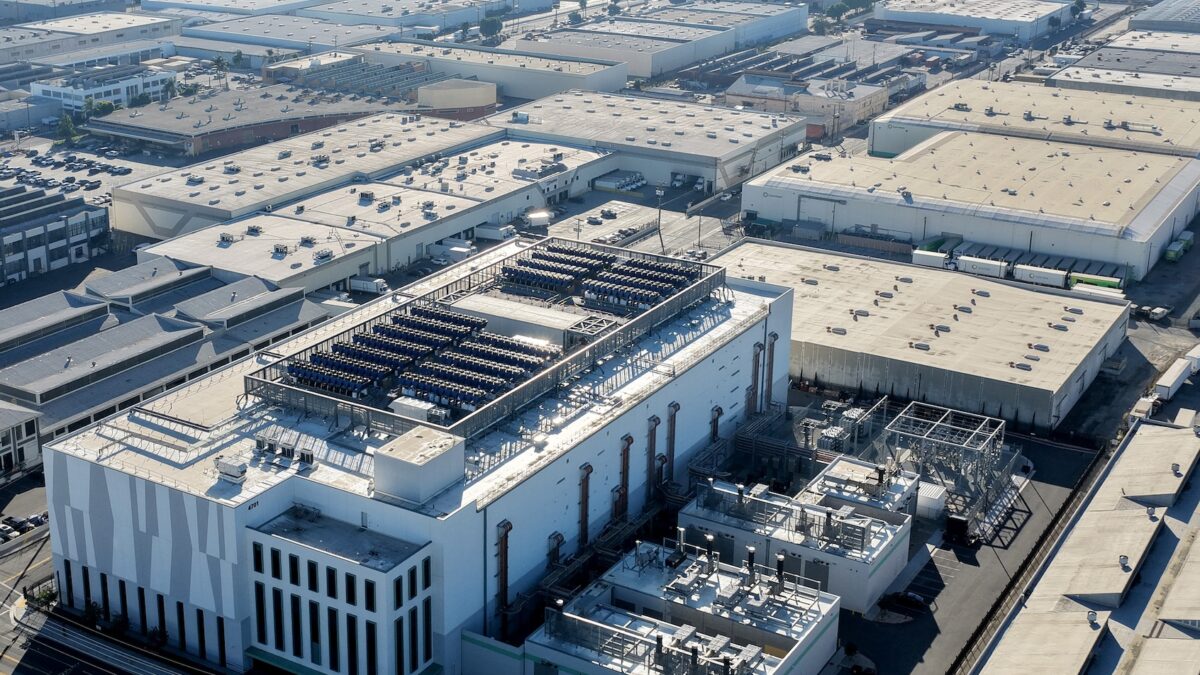
It was cut to a third of its original capacity. The original design contemplated cooling with potable water supplied by OSE, which generated public controversy in the aftermath of the 2022–23 drought. The revised environmental filing reduced the data centre’s capacity to one third of the original and replaced the cooling system with 32 air-cooled chillers running a closed water circuit. A ministry official put it plainly at the time: the project continues, and it will be smaller.
The sequence therefore was not that engineering quietly absorbed local water constraints. It was: original design, public conflict, redesign, and a substantial reduction in scale.
It will employ about fifty people. Construction employs 300 to 400 workers with a peak near 800, across four stages over 26 months from the August 2024 groundbreaking. Once operational, the facility will be staffed by around fifty people, running continuously, 24 hours a day, 365 days a year, on UTE supply.
Fifty permanent staff generates essentially no office demand and very limited local service demand. The 800-person peak is temporary and, on the stated timeline, largely behind us. Any assessment of induced property demand has to start from those numbers rather than from the headline investment figure.
The connectivity: Firmina, precisely
The Firmina subsea cable is correctly identified as part of the equation, and worth describing accurately. It runs roughly 13,500 km from Myrtle Beach, South Carolina, to Las Toninas, Argentina, with additional landings at Praia Grande, Brazil, and Punta del Este, Uruguay. It entered service in April 2024 after being announced in June 2021, and it is the first cable to connect Argentina and Uruguay directly to the United States, as well as the first to deploy twelve fibre pairs on a North–South American trunk.
Two corrections to the common description. Uruguay is a branch landing rather than a terminus — the trunk runs to Las Toninas. And the cable is co-owned: Telxius, the Telefónica group’s connectivity arm, shares ownership with Google, and counts Firmina alongside SAM-1, BRUSA and Tannat in its Atlantic routes.
Tannat, which already linked Uruguay to Brazil, remains the other relevant piece.
The corridor was already a corridor
This is where the standard narrative most needs correcting. Google did not create a logistics submarket on Ruta 101. It arrived in one.
Parque de las Ciencias is a free zone whose first plots were bought in 2008, authorised by the Executive in 2009, with operations beginning in 2011. It occupies roughly 85 hectares — 55 developed initially, with 30 more reserved for growth — and hosts more than 60 companies, over 80% of them in life sciences, high technology and high value-added activity: pharmaceutical and veterinary laboratories, specialist engineering and cleanroom providers, GMP production plants, and logistics operators specialised in health products.
Its anchor is Megalabs, with a plant of over 22,000 sqm and an investment of USD 110 million. Electrical capacity was addressed at the outset: an agreement with UTE installed a transmission line along Ruta 101, benefiting both the free-zone occupiers and the surrounding population.
And the land window was already tightening five years ago. By December 2021 the corridor was being described as a logistics corridor in full swing, with the park’s commercial manager noting that available plots fronting the highway were by then countable — few remaining, though not none. The developer Sammel began searching for land in December 2020 and is building the Parque Logístico San Juan on what it found.
All of that predates confirmation of the Google project.
What that means for land banking
The land-banking case for the Ruta 101 corridor is not wrong, but it needs restating honestly.
The primary actor already executed it. Google’s subsidiary bought 30 hectares inside Parque de las Ciencias in 2021, four years before construction, and by a Ministry of Economy resolution those plots were incorporated into the free zone’s extension. An investor entering now is not moving ahead of the market; they are moving after the anchor tenant, after the pharma cluster, and after at least one logistics developer.
The decisive variable for adjacent land is therefore not proximity but regime. Land inside the free zone perimeter carries a tax position that land across the road does not, and whether a given plot can be incorporated into a free-zone extension — as Google’s was — is a specific administrative question with a specific answer. Any evaluation that treats “near the data centre” as the criterion is measuring the wrong thing.
The other conditions remain as stated in general terms: access to high-capacity substations, proximity to trunk fibre, heavy-transport access, and compatible industrial-technology zoning. What no public source provides is comparable land pricing for the corridor. That absence should be stated rather than papered over: anyone underwriting this thesis needs transaction comparables that are not in the public record, and should obtain them locally before committing.
The logistics demand, sized realistically
A hyperscale facility does generate a physical supply chain: transport of high-specification equipment during construction, storage of critical spares for maintenance, and operational supplies once running. That demand carries higher security standards, access control and in some cases controlled environmental conditions, which raises the technical specification — and therefore the rental value — of logistics space serving it.
Three qualifications keep the estimate honest. The construction-phase component is finite and, on a 26-month schedule begun in August 2024, is late in its cycle. The operational component is sized to a fifty-person facility, not to a manufacturing plant. And the corridor already hosts specialised logistics operators serving the pharmaceutical cluster, so incremental demand competes with existing capacity rather than arriving in a vacuum.
The realistic reading is that a data centre reinforces an existing logistics corridor at the margin. It does not create one.
What is genuinely replicable
The stronger argument in this chain is not about one project’s spillover but about the country’s position for the next one.
Uruguay now has a verifiable precedent rather than a promise: a hyperscaler that evaluated the jurisdiction, negotiated from 2018 through confirmation, secured a free-zone position, resolved an environmental conflict, and built. The combination that supported it — grid stability with clean origin, direct subsea connectivity to the United States, an operating free-zone regime and predictable institutions — is structural rather than one-off.
Two cautions attach. The Google timeline ran roughly eight years from first contact to construction, which is the realistic clock for a comparable project. And the water episode established that these projects face genuine environmental scrutiny in Uruguay: the government authorised construction subject to seven conditions, and the capacity reduction shows the constraint has teeth.
Conclusions
Uruguay’s grid advantage is real and its data centre is real. The property consequence is smaller and later than the causal chain implies.
The facility employs about fifty people, was cut to a third of its planned capacity, sits inside a free zone that has operated since 2011 with sixty-plus companies already installed, and occupies land its owner bought in 2021 — in a corridor where roadside plots were already scarce by the end of that year. The land-banking window on Ruta 101 opened around 2008 and has been closing since.
What remains open is the next site. For an investor, the more useful question is not which plots sit near Canelones, but which other locations in Uruguay combine substation capacity, fibre, free-zone eligibility and water-neutral cooling feasibility — because that is the specification the next project will be shopping for, and it is not corridor-specific.
Verification checklist
| Claim | Source | Watch for |
|---|---|---|
| 98% renewable, 2025 | MIEM preliminary balance | Preliminary; national basis |
| Hydro 46 / wind 34 / biomass 14 / solar 4 | ADME | SIN basis, not MIEM’s — do not combine with the 98% |
| USD 850m investment | Company and government statements | Announced figure; capacity reduced to one third of original design |
| Permanent employment ~50 | Project reporting at groundbreaking | Construction peak ~800 is temporary |
| Reasons cited for site selection | Eduardo López, Google Cloud LatAm | Access, connectivity, energy availability, legal security |
| Firmina | Google / Telxius | Uruguay is a branch landing; co-owned with Telxius |
| Parque de las Ciencias | Free-zone operator; Uruguay XXI | ~85 ha, 60+ companies, operating since 2011 |
| Land pricing in the corridor | — | No public comparables identified; obtain locally |
Sources
MIEM — preliminary national energy balance 2025; ADME — generation delivered to the SIN; Intendencia de Canelones and Agencia de Promoción a la Inversión de Canelones — groundbreaking coverage, with statements by Eduardo López (Google Cloud Latin America) and ministers Omar Paganini and Elisa Facio; Ministerio de Ambiente, Observatorio Ambiental Nacional — Proyecto Google Datacenter file; Uruguay XXI — Parque de las Ciencias directory entry; Presidencia de la República — Parque de las Ciencias coverage; Google and Telxius — Firmina announcements and entry into service; reporting by El Observador, Subrayado, Infobae, La Nación and TeleSemana.
Figures were current at the time of writing and draw on company statements, government filings and press reporting rather than a single primary dataset. Energy figures for 2025 are preliminary. No public land-price comparables for the Ruta 101 corridor were identified; the land-banking discussion above is analytical, not a valuation. General information on commercial property markets. Not investment, tax or legal advice.