On 5 August 2026 the Panama Canal Authority wrote that the capacity of the locks remained stable and that no reduction of transit slots was being implemented. On 20 August it reduced the daily slots. Both texts are official advisories from the same issuer, fifteen days apart, and neither corrects the other. What follows is the chronology of how that point was reached, document by document.
12 September 2025: the slot becomes a product
Advisory A-27-2025 launched the NetZero Slot, a weekly slot reserved for neopanamax customers inside the booking system. The first competition was set for 3 October 2025, for transits in the week of 2 to 8 November 2025, with a competition window from 08:00 to 08:30 on the opening day of Booking Period 1A.
What it changed. One slot of period 1A ceased to be available to the customer base as a whole and came to be allocated on a criterion other than price. From that day, the number of slots an operator sees on the open market and the total number of slots in the day stopped being the same figure.
27 and 30 October 2025: the long-term slot becomes expensive to cancel
Advisory A-33-2025 recalled that full container, LNG and LPG vessels are not eligible for the FlexSlot+ packages within the LoTSA 2.0 programme. Three days later, Advisory A-34-2025 fixed the cost of cancelling: 80% of the awarded amount if the cancellation is submitted 15 days or more before the required arrival date, under tariff 1050.IBC10, and 100% if submitted less than 15 days before, under tariff 1050.IBC8. Slots awarded under LoTSA 1.0 in 2025 kept the previous policy.
What it changed. The long-term slot acquired an explicit exit value. For anyone planning a warehouse around an arrival window, the cost of being wrong about the date became a percentage of the bid rather than a generic penalty.
18 May 2026: the auction becomes partly observable
Advisory A-16-2026 updated subsection L of article 22, section 16 of Notice to Shipping N-7. Since then, once the auction closes, the complete bid information is available in the bidding history exclusively to the participating parties, and a daily box plot table covering the previous seven days is also published, accessible after registration on a self-service platform.
What it changed. The price of the slot stopped being invisible to whoever participates, and remained invisible to whoever does not. That asymmetry is what today defines who can estimate the transit cost of a chain and who has to ask a third party for it.
5 August 2026: the draft is adjusted and no cut is stated
Advisory A-25-2026 set the maximum authorised draft in the Neopanamax locks at 14.63 metres (48.0 feet) tropical fresh water from 26 August 2026, and at 14.48 metres (47.5 feet) from 3 September 2026 until further notice. In the same text the Authority stated that the capacity of the Neopanamax and Panamax locks remained stable and that no reduction of available slots was being implemented “at this time”.
What it changed. A draft adjustment reduces cargo per vessel without touching the number of vessels. For a logistics chain that moves the problem from the calendar to the volume: the same number of transits carries fewer tonnes.
20 August 2026: two advisories on the same day
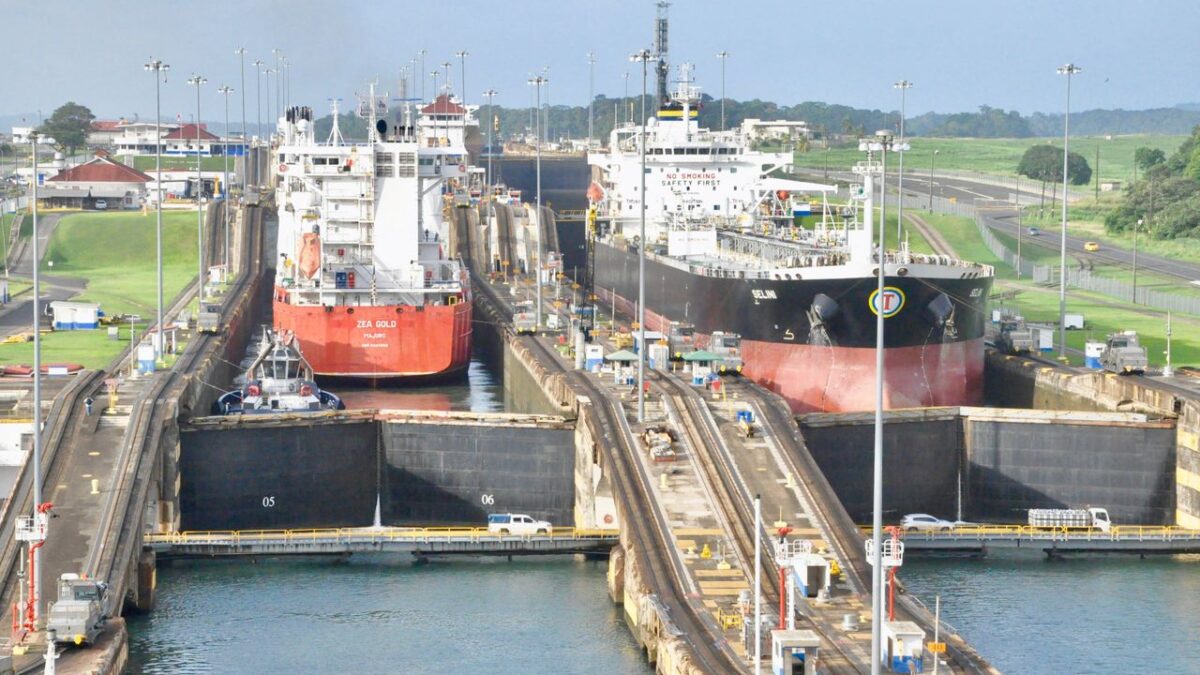
Advisory A-29-2026 reported that, in the current hydrological year from May to August, cumulative rainfall across the watershed was 34% below the historical average and watershed inflows 44% below theirs. On that basis it set that, from 21 August 2026 and for booking dates from 4 September, daily slots at the Neopanamax locks fall to nine, with only one in Booking Period 2, and Panamax slots to twenty-five, with one slot for Regular vessels in that same period; the Conditioned slot in Neopanamax ceases to be offered. From 1 September 2026, for booking dates from 15 September, Panamax slots fall to twenty-three, with eight for Super vessels in Booking Period 2 and a maximum of nine Supers per direction.
The same day, Advisory A-28-2026 changed how what remains is allocated. From 21 August 2026 auction slots may be offered by market segment group: LNG and LPG in group 1; dry bulk, general cargo and others in group 2; full container in group 3; vehicle carriers, refrigerated, chemical tankers and crude or product tankers in group 4. Only one slot per customer per day is allowed during the competition, and whoever already obtained a slot for that date, including LoTSA and NetZero, is excluded unless there are no other competitors. The advisory itself compares the method with the one applied temporarily on 29 November 2023.
What it changed. On a single day the Canal reduced the number of slots and rewrote the rule deciding who reaches those that remain. The two measures act in different directions: the first contracts supply, the second spreads it across more cargo types.
The sequence also orders the three decisions an occupier takes on different horizons. Booking a slot is decided in days; the composition of the fleet serving a route, in months; the lease of the warehouse receiving that cargo, in years. Each advisory hits the shortest horizon first and reaches the longest only if it repeats. The useful question in the face of each advisory is therefore not how much changes today, but how many times it has changed in the same direction over the past year.
Transit slots: the divergence between the advisories of 5 and 20 August
The text of 5 August says that no reduction of slots is being implemented “at this time”; the one of 20 August implements it. Neither is incorrect: the first carries the temporal reservation within it, and the second rests on rainfall and inflow figures the first does not mention. What the sequence shows is speed, not an error: fifteen days separate a statement of stability from a cut effective the day after its publication.
For anyone signing a logistics lease in Colón or on the Pacific side, that speed is the datum. A three or five-year contract is negotiated on transit assumptions, and the issuer of those assumptions can change them with one day’s notice. The operative conclusion is not that the Canal is unpredictable, but that the horizon of its decisions is measured in weeks while that of the property is measured in years.
It is worth fixing what neither advisory says. Neither states the level of slots in force before 21 August 2026, so the size of the cut cannot be read from these texts: the destination is known, the starting point is not. Neither mentions an end date for the new level, except the draft, which holds “until further notice”. And neither translates slots into tonnes, because the draft adjustment and the slot adjustment act on different variables and the Canal does not publish the equivalence between them.
Where it leads
Three indicators will show what happens next, and all three are published by the Canal itself. The first is the daily Projected Booking Slots Availability table, which shows which segment groups compete each day and therefore whether allocation by group holds or is withdrawn. The second is the draft advisories for Neopanamax, which today set 14.48 metres from 3 September 2026 with no end date. The third is the monthly operations summary, which appears in the same advisory series and allows the aggregate effect to be seen without relying on outside estimates.
What they will not show is the price. The complete bid information is visible only to the participants in each auction since 18 May 2026, and the seven-day dispersion table requires registration. Any transit cost figure quoted outside that circuit comes from a third party, and none is quoted in this material.
Este material tiene carácter informativo y no constituye asesoramiento legal, fiscal ni financiero. No se cita ningún precio de cupo de subasta, ninguna renta ni vacancia de bodegas en Colón o el lado Pacífico, y ningún volumen de tránsitos de 2026: esas cifras no fueron verificadas en fuentes primarias para este texto.