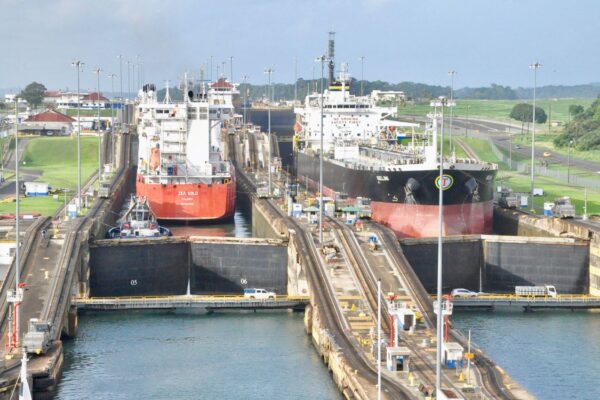
In Panama, no warehouse is understood without the Canal. That is not a metaphor: transit capacity determines how much cargo moves by water and how much accumulates on land, and that ratio shapes demand for storage space in Colón and Panamá Pacífico.
But 2026 has two separate pressures on the Canal, and most analysis collapses them into one. Water management — a confirmed El Niño and preemptive draft cuts — is the one that gets attention. A demand shock from the Middle East is the one actually driving slot scarcity and auction prices. They move independently, and a logistics operator planning inventory needs to read both.
The baseline: recovery, then a different kind of pressure
After the 2023–24 drought forced the Panama Canal Authority (ACP) to cut draft and daily transits to historic lows, fiscal year 2025 closed with a clear recovery. The ACP reported roughly USD 5.7 billion in revenue, up 14.4% year on year, on 13,404 transits. These FY2025 figures should be confirmed against the ACP’s own release before republication; they are consistent with the recovery but were not independently verified for this article.
Two corrections to the way that baseline is usually described. Daily transits in 2026 have run above the figure commonly cited as near-maximum: roughly 34 vessels a day in January, 37 in March, with peak days exceeding 40. And the ACP has expanded capacity by about 15%, according to its vice-president of finance, who added that the duration of those higher volumes depends on the rainy season arriving on time.
The pressure that is not about water
The defining event for the Canal in 2026 is geopolitical.
Iran effectively closed the Strait of Hormuz to commercial shipping on 28 February 2026, the US established its own blockade, and the IRGC confirmed the formal closure on 2 March. Roughly a fifth of global oil supply and all of Qatar’s LNG normally pass through it. Asian buyers — particularly in India, where LPG is a household cooking fuel — pivoted sharply toward US Gulf Coast suppliers, and the Panama Canal is the most direct route between those supply points and Asian markets.
The same escalation suspended Suez transits, affecting 10.7% of the global container fleet by TEU capacity and adding 10 to 14 days per voyage via the Cape of Good Hope. Two chokepoints closed at once.
This, not drought, is what moved auction prices. The median slot price between October 2025 and February 2026 was around USD 55,000. Before the escalation it ran USD 135,000–140,000. Through March and April the average reached roughly USD 385,000, and April–May USD 385,000–425,000 — a tripling.
The USD 4 million figure that circulates is a documented outlier with a name and a date: the Gas Virgo, a Singapore-flagged LPG tanker operated by Wanhua Chemical, transited on 15 April 2026 having paid that amount, and the ACP confirmed the payment after Bloomberg reported it. The canal’s administrator explained that the vessel carried fuel originally destined for Europe and was rerouted to Singapore, prompting the operator to pay a record premium for rapid transit. The level is comparable to the November 2023 drought peak; the cause is not.
Two mechanics matter for planning: the ACP auctions only three to five slots per day, most vessels transit on advance reservation, and the authority’s position is that these prices reflect market-driven urgency rather than congestion or official tariff increases.
The water track, running separately
NOAA’s Climate Prediction Center has El Niño at Advisory status, continuing and strengthening through the end of the year, with a 97% chance of persisting into early spring 2027. The mid-July model ensemble had 23 of 26 models forecasting a very strong event peaking in October–December 2026.
The ACP has responded with staged, preemptive draft reductions at the Neopanamax locks:
| Step | Draft (TFW) | Status |
|---|---|---|
| 3 July 2026 | 15.09 m (49.5 ft) | Superseded |
| 24 July 2026 | 14.94 m (49.0 ft) | Superseded |
| 15 August 2026 | 14.78 m (48.5 ft) | In force |
Against a design reference of 15.24 m (50 ft), the cumulative reduction is roughly 46 centimetres. At the worst of 2023–24 the authorised draft fell to around 44 feet. These are moderate adjustments by that standard, and the ACP framed the first as preventive, based on lessons from the 2023–24 shortage, with limited immediate effect on shipping.
The critical distinction for a warehouse thesis: draft limits tons per vessel, not the number of transits. On current data the ACP does not foresee general transit restrictions in 2026. A lower draft means ships sail lighter; it does not mean fewer ships.
LoTSA 2.0: what changed and what it was for
The ACP’s long-term slot allocation programme was revised. Announced on 29 September 2025, with sealed bids on 28 October and implementation from 15 November, LoTSA 2.0 replaced a single 12-month horizon with two 6-month cycles — the first running 4 January to 4 July 2026, the second from 5 July 2026 to 3 January 2027. Average daily slots under the programme fell from four to three, and packages were segmented into Fix and Flex variants for container, LNG and LPG vessels.
The reduction from four to three is usually reported as a squeeze on operators. The ACP’s stated intent was the opposite: as Lloyd’s List reported, cutting the long-term allocation makes more slots available for spot bookings and daily auctions. The design shifts certainty into shorter cycles and leaves the spot window as the pressure valve.
For a shipper, the practical consequence is that long-term coverage is thinner and re-bid every six months, which does increase exposure to spot pricing — and spot pricing, as above, is currently being set by Hormuz rather than by rainfall.
What this means for warehouse demand — and what we cannot yet show
The logic connecting canal conditions to storage demand is sound in direction: when transit timing becomes less predictable, supply chains hold larger on-land buffers rather than smaller ones, and buffer inventory needs space.
Three channels are plausible for Colón and Panamá Pacífico:
- Buffer inventory against slot uncertainty. Shorter LoTSA cycles and volatile auction pricing push operators toward holding stock rather than relying on a scheduled transit.
- Partial offloading. Where draft restricts cargo per vessel, some operators move a portion overland or through intermediate storage, which converts a water constraint into demand for square footage near the terminals.
- Redistribution role. The Colón Free Zone’s function as a break-point toward the Caribbean and Central America means added regional flow lands there first; Panamá Pacífico, with a more industrial and isthmus-facing profile, absorbs it later but on longer leases.
What no public source provides is the evidence. There are no published vacancy rates, rent levels or absorption figures for Panamanian logistics real estate that would confirm any of these channels are operating in 2026. That absence should be stated rather than papered over. The mechanism is reasonable; the magnitude is unmeasured.
Anyone underwriting on this basis needs occupancy and rent data obtained directly from local brokerage or from the free-zone operators, not inferred from canal statistics.
What to actually watch
Rather than a two-scenario framework built on water alone, the variables that move this market in the next two quarters are:
| Variable | Where to check | Why it matters for storage demand |
|---|---|---|
| Hormuz and Red Sea status | Shipping and geopolitical reporting | The current driver of slot scarcity; reopening would ease it faster than rain would |
| Auction clearing prices | ACP; Argus | Average versus outlier; the tripling is the signal, not the USD 4m headline |
| Authorised draft | ACP Advisories to Shipping | Affects tons per vessel, not transit count |
| Gatún Lake level | ACP water-level dashboard | Live figure; earlier-year peaks are not current |
| ENSO status | NOAA CPC diagnostic discussion | Updated the second Thursday monthly |
| LoTSA second-cycle auction | ACP advisories | Cycle runs to 3 January 2027; pricing indicates forward slot demand |
| Warehouse occupancy and rents | Local brokerage; ZLC and Panamá Pacífico operators | The missing link; no public series identified |
Conclusions
Panama’s logistics property market cannot be read from the Canal alone, but it cannot be read without it either. What matters is separating the two pressures.
Water management is proceeding preemptively and moderately: a 46-centimetre cumulative draft reduction, framed by the ACP as precautionary, with no general transit restrictions foreseen. That limits cargo per vessel, not vessel count.
Slot scarcity and auction pricing are being driven by the closure of Hormuz and the Red Sea, which redirected energy cargoes onto the Panama route and tripled average premiums. That is the variable to watch, and it can reverse faster than a hydrological cycle.
The direction of the warehouse thesis holds: transit uncertainty argues for larger on-land buffers, which favours well-located storage with efficient access to terminals on both oceans. The magnitude is not yet demonstrable from public data, and anyone committing capital should obtain occupancy and rent evidence locally before treating the mechanism as a measured trend.
Sources
Panama Canal Authority — Advisories to Shipping including A-18-2026, A-22-2026 and A-28-2025 (LoTSA 2.0), fiscal-period results releases, LoTSA 2.0 terms and conditions, and statements by Administrator Ricaurte Vásquez and VP Finance Víctor Vial; NOAA Climate Prediction Center — ENSO Diagnostic Discussion, 9 July 2026; IRI/CCSR mid-July 2026 model ensemble; reporting by Bloomberg, Lloyd’s List, Argus, gCaptain, Seatrade Maritime, Splash247, La Prensa Panamá and bne IntelliNews.
Operational figures were current at the time of writing and change frequently; the draft schedule, lake level, auction prices and LoTSA cycle status should be checked against current ACP advisories before use. FY2025 revenue and transit figures were not independently verified for this article. No public occupancy or rent series for Panamanian logistics real estate was identified; the demand analysis above is analytical, not a measured market observation. General information on commercial property markets. Not investment, tax or legal advice.