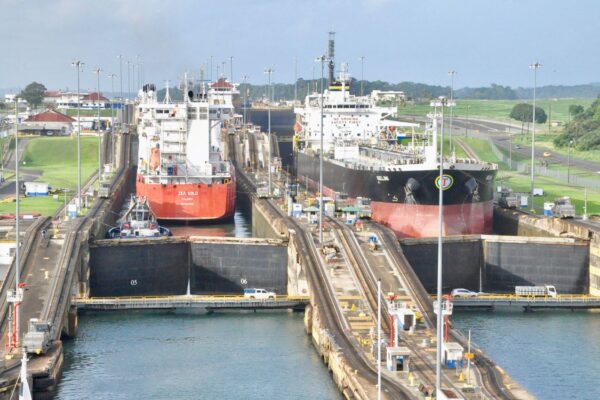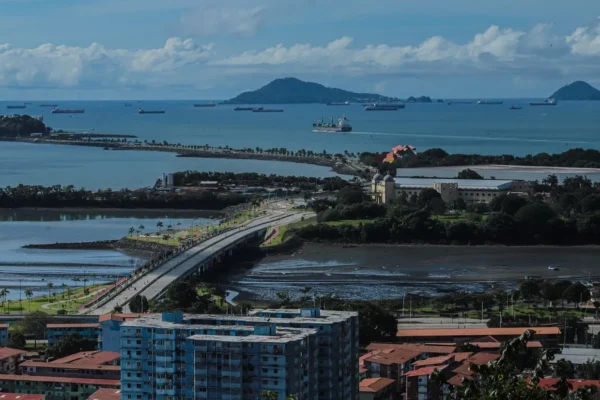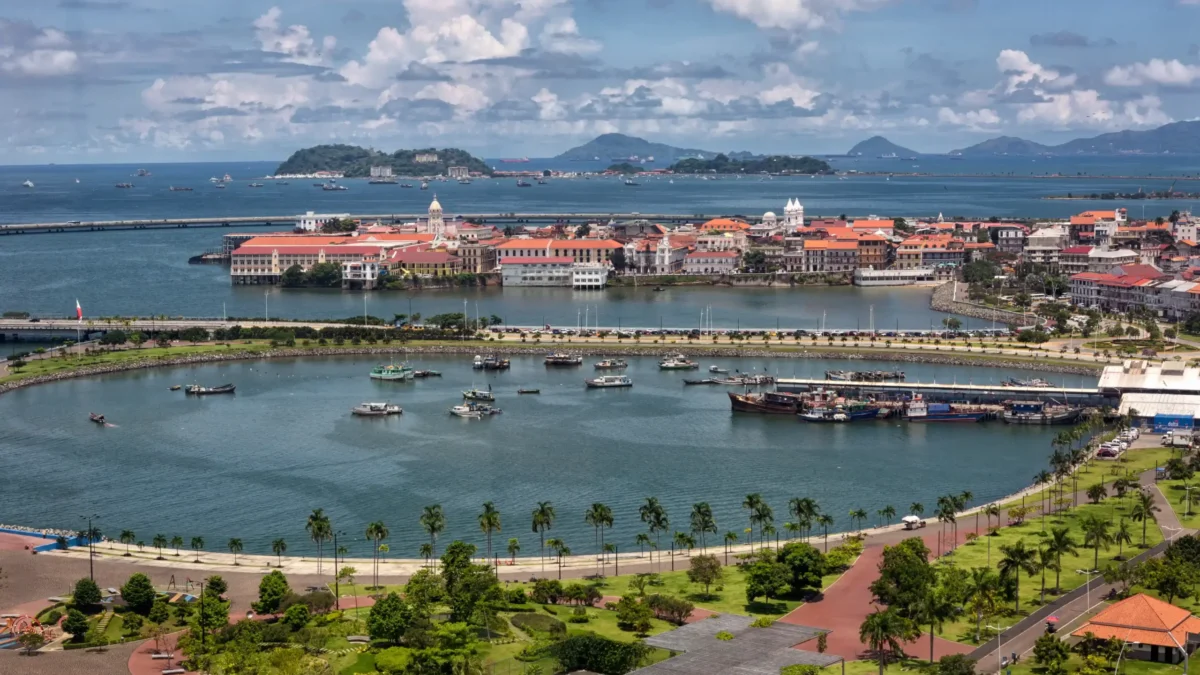
Twenty minutes apart by car, Costa del Este and Casco Viejo sit at almost opposite poles of Panama City’s commercial property market. One is corporate: glass towers, Grade-A floor plates, banks and multinational headquarters. The other is the colonial quarter, a UNESCO World Heritage Site since 1997, where boutique hospitality and retail occupy restored buildings in the country’s densest tourist corridor.
They are routinely bundled together as “offices and retail in Panama.” They should not be. They serve different tenants, respond to different demand signals, and — the point most comparisons miss — carry risks that are not merely different in degree but different in kind.
One asymmetry shapes this analysis and is worth stating at the outset. The Casco Viejo demand story is documented monthly by the Autoridad de Turismo de Panamá and INEC. The Costa del Este office story is not: current inventory, vacancy and rent data sit in subscription or registration-gated brokerage reports, and public reporting on them is thin and dated. Where figures below are old, they are labelled as such. Where they are absent, the final section says where to obtain them.
Costa del Este: the corporate submarket
Developed from the late 1990s as a planned extension of the city, Costa del Este holds a significant share of Panama’s newest office inventory — buildings with efficiency certifications and larger floor plates than the older towers of Calle 50 and Marbella.
The tenant base is regional banks, insurers, international law firms, shared-services centres, and companies operating under the Multinational Headquarters (SEM) regime. What they have in common is a requirement for large contiguous floors, structured parking, and access to both the Corredor Sur and Tocumen airport.
Connectivity is better than the “highway and airport” shorthand suggests. Metro Line 2 runs elevated above the Corredor Sur, with the Hospital del Este station open since April 2019, and the line’s extension toward Tocumen adds a transit connection that the traditional banking district does not have on the same axis.
On market position, the most specific public data available is now several years old and should be treated as historical rather than current. Colliers data reported in early 2023 described the Este submarket — Costa del Este together with Santa María — as having become the city’s new commercial district, and recorded it as the second most active submarket by demand in Q4 2022 and the leader in net absorption for the full year 2022, with 24,000 sqm representing half of the city’s annual absorption. For scale in the same series, the San Francisco submarket then held 30 buildings and 416,000 sqm of inventory, of which 295,000 sqm was occupied, at an asking rent of $16.11 per sqm per month.
Those figures establish the submarket’s trajectory. They do not describe 2026, and no investor should use them as though they did.
The risk in Costa del Este is not the one usually named
The standard account is that Costa del Este’s exposure is cyclical oversupply: several towers complete in the same window, absorption lags, asking rents soften until the corporate market catches up. That is a real mechanism, and it has happened before.
It does not appear to be the current condition. Through 2024 the Panamanian office market saw no new inventory enter and few future projects registered, in a construction cycle depressed by the election period; private construction permits fell 17.6% in value and 25.9% in area in the first half of 2024, with non-residential permits down 50%, and construction’s share of GDP sat at 15% against 19% in 2019. A market with a thin pipeline and no recent deliveries is not, at that moment, an oversupply market.
Two other risks deserve the attention that oversupply usually receives.
Concentration. Costa del Este is the most corporate-dependent submarket in the city: it leases quickly and holds value while multinational demand is healthy, and carries meaningful concentration risk if those companies downsize or relocate. Its tenant base is narrower than the city’s as a whole, which is what makes it stable in good conditions and correlated in bad ones.
Regulatory dependency on the tenant base. This is the one most often missed. A material share of Costa del Este’s occupiers are there because of the SEM regime and Panama’s territorial tax system — that is, because of policy. Policy has been moving. Law 526 of 28 May 2026 introduced economic substance requirements for entities forming part of multinational groups receiving foreign-source passive income, effective from fiscal year 2027, and Panama remains on the EU’s list of non-cooperative tax jurisdictions pending its next revision. Neither change targets office occupiers directly. Both alter the calculus of holding a Panamanian corporate presence, which is the demand that fills these floors.
An investor underwriting Costa del Este on a five-to-ten-year horizon is therefore underwriting a policy environment as much as a building.
Casco Viejo: measurable demand, physical scarcity
Casco Viejo — also Casco Antiguo — is the city founded after the 1671 sack of Panamá Viejo and relocated in 1673. Its inscription as a UNESCO World Heritage Site in 1997 has been followed by nearly three decades of private restoration. The resulting inventory is the opposite of Costa del Este’s: small buildings, irregular floor plates, high architectural value, and a heritage regime that governs every intervention.
The tenant base is boutique hotels, chef-driven restaurants, galleries, niche retail aimed at international visitors, and increasingly creative and design offices choosing an address with character over corporate uniformity. Foot traffic, not road access, drives value.
And unlike the office side, that demand is measured. Panama received 1,755,998 international visitors between January and June 2026, a 17.4% increase on the same period of 2025, with an estimated economic contribution near $3.5 billion. National hotel occupancy over the half-year reached 67.6%, up 14 percentage points year on year, per Apatel. The Panama Stopover programme with Copa Airlines brought more than 132,000 visitors in the first half of 2026, up 37%. The ATP publishes monthly arrivals, tourist spending and occupancy figures compiled with INEC data.
Casco Antiguo specifically outperforms the national average by a wide margin. The ATP put hotel occupancy in Casco Antiguo at 95% in 2026, against 90% in the country’s interior. During Semana Santa 2026 the authority estimated that more than 300,000 people circulated through the quarter.
That 95% against a 67.6% national half-year average is the seasonality the qualitative literature gestures at, expressed as a number: the peak is very high, and the gap between peak and average is where the revenue variance lives.
But seasonality on a rising trend is a different risk from seasonality on a plateau. Visitor arrivals are up 17.4%, occupancy up 14 points, Stopover up 37%, and the ATP projects Panama will exceed three million visitors in 2026. An investor pricing Casco Viejo exposure should separate the within-year variance, which is real, from the multi-year direction, which is currently favourable — and should model what happens if that direction reverses, since a tourism-anchored asset has no corporate lease to fall back on.
The heritage regime: cost and compensation
The article-length version of “heritage permits are complex” is not useful to an investor. The specifics are.
Interventions in the Conjunto Monumental Histórico are governed by Panama’s historic-monument legislation and administered through the Dirección Nacional de Patrimonio Histórico of INAC, with a dedicated office for the Casco Antiguo. Approval is required for works affecting protected fabric, and the process is a genuine constraint on timeline and design freedom in a way that has no equivalent in Costa del Este.
That constraint cuts both ways, and both directions belong in the model:
- It caps supply physically. New inventory cannot simply be built. This is the structural reason a restored, commercially enabled property in Casco Viejo holds value differently from a tower that can be replicated on the next lot.
- It is partially offset by fiscal incentives. Panama has maintained specific tax incentives for restoration within the historic district. Their current terms should be verified against the legislation in force before they are relied on in a model, but omitting them entirely — as most comparisons do — overstates the net cost of a restoration project.
Side by side
| Criterion | Costa del Este | Casco Viejo |
|---|---|---|
| Dominant use | Grade-A offices, corporate mixed use | Boutique hospitality, retail, dining |
| Typical tenant | Banks, multinationals, SEM headquarters | Boutique hotels, niche brands, creative offices |
| Demand driver | Corporate occupier demand; Corredor Sur, Metro Line 2, Tocumen | International visitor flow |
| Demand data availability | Limited public data; brokerage reports gated | Monthly ATP/INEC statistics, publicly available |
| Documented demand indicator | Este submarket led 2022 net absorption (24,000 sqm, ~50% of city total) — historical | Casco Antiguo hotel occupancy 95% in 2026; national average 67.6% H1 |
| Supply barrier | Low — developable land available | High — heritage protection caps new inventory |
| Current supply condition | Thin pipeline; no new office inventory entered in 2024 | Structurally constrained |
| Principal risk | Tenant concentration and policy dependency (SEM, territorial tax) | Within-year seasonality; restoration cost and permitting |
| Offsetting factor | Metro connectivity; limited near-term competition | Rising visitor trend; restoration tax incentives |
| Typical contract term | 3–5 years | Variable, often shorter in tourist-facing retail |
Which profile suits which investor
Neither is superior in the abstract; they answer different mandates.
Costa del Este suits capital seeking rent tied to structural corporate demand, with low seasonality and long leases. The exposure to understand is not the delivery cycle — which is currently quiet — but the narrowness of the tenant base and its dependence on a tax and headquarters regime that is actively being revised. This is a bet on Panama’s continued attractiveness as a corporate domicile.
Casco Viejo suits capital that can absorb permitting complexity and restoration cost in exchange for a supply barrier that no competitor can build around, and that is comfortable with revenue tracking visitor arrivals. This is a bet on Panama’s tourism trajectory. It happens to be the better-documented of the two bets, which is not the same as the safer one.
The framing question is not which yields more. It is which of two very different dependencies — corporate policy or visitor flow — the investor is better positioned to read and to survive.
Where to get the data
Because the public evidence is uneven between the two submarkets, the practical step for anyone underwriting either is to go to the primary series rather than to secondary commentary.
| What | Where | Note |
|---|---|---|
| Office inventory, vacancy, absorption, rents | Colliers Panama quarterly office report | Free download on registration; the only regularly published Panama-specific office series identified |
| Regional office cost benchmarks | Newmark regional reports | 2025 figures placed Panama at $980/sqm efficient, $1,240 mid, $1,500 high |
| Visitor arrivals, spending, hotel occupancy | ATP, Estadísticas e Información del Mercado | Monthly, compiled with INEC data |
| Hotel occupancy by segment | Apatel | Reported alongside ATP quarterly balances |
| Construction permits and pipeline | Contraloría / INEC; CAPAC | Leading indicator for future office supply |
| Heritage permitting | Dirección Nacional de Patrimonio Histórico, INAC | Confirm current requirements and any restoration incentives before modelling |
| SEM regime and tax changes | Law 526 of 2026; MICI for SEM licensing | Substance rules effective FY2027; regulations pending |
Sources
Autoridad de Turismo de Panamá — Q2 2026 balance and monthly market statistics; INEC / Contraloría General de la República; Asociación Panameña de Hoteles (Apatel); Colliers Panama — office market reporting, including 2022–23 submarket data reported via Martes Financiero; Newmark — regional office cost comparison, 2025; Cámara Panameña de la Construcción (CAPAC) and construction-permit reporting for 2024; Law 526 of 28 May 2026, Gaceta Oficial No. 30534-B; Council of the European Union — list of non-cooperative tax jurisdictions; UNESCO World Heritage List, inscription 1997.
Office-market figures cited above date from 2022–2023 and are included as historical context, not as current market indicators; they should be replaced with current brokerage data before use. Tourism figures are current to the first half of 2026. General information on commercial property markets. Not investment, tax or legal advice. Roksolana Pyrtko Editorial is not a licensed real estate adviser in Panama; for specific decisions, consult a professional licensed in the jurisdiction.